Thank you for your interest in our research! You are being invited to take part in a research study investigating human walking and movement. Before you decide, it is important that you understand why the research is being done and what it will involve. Please take time to read this information carefully and discuss it with others if you wish.
Study title: STEPS: Simulating Hominin Locomotion Across Complex Terrains.
ABOUT THE STUDY
The study aims to collect high-resolution movement data of humans walking across a variety of surfaces, ranging from uneven terrains to soft foams. This information will help us understand how humans move and how locomotion evolved in our ancestors.
WHAT AM I EXPECTED TO DO?
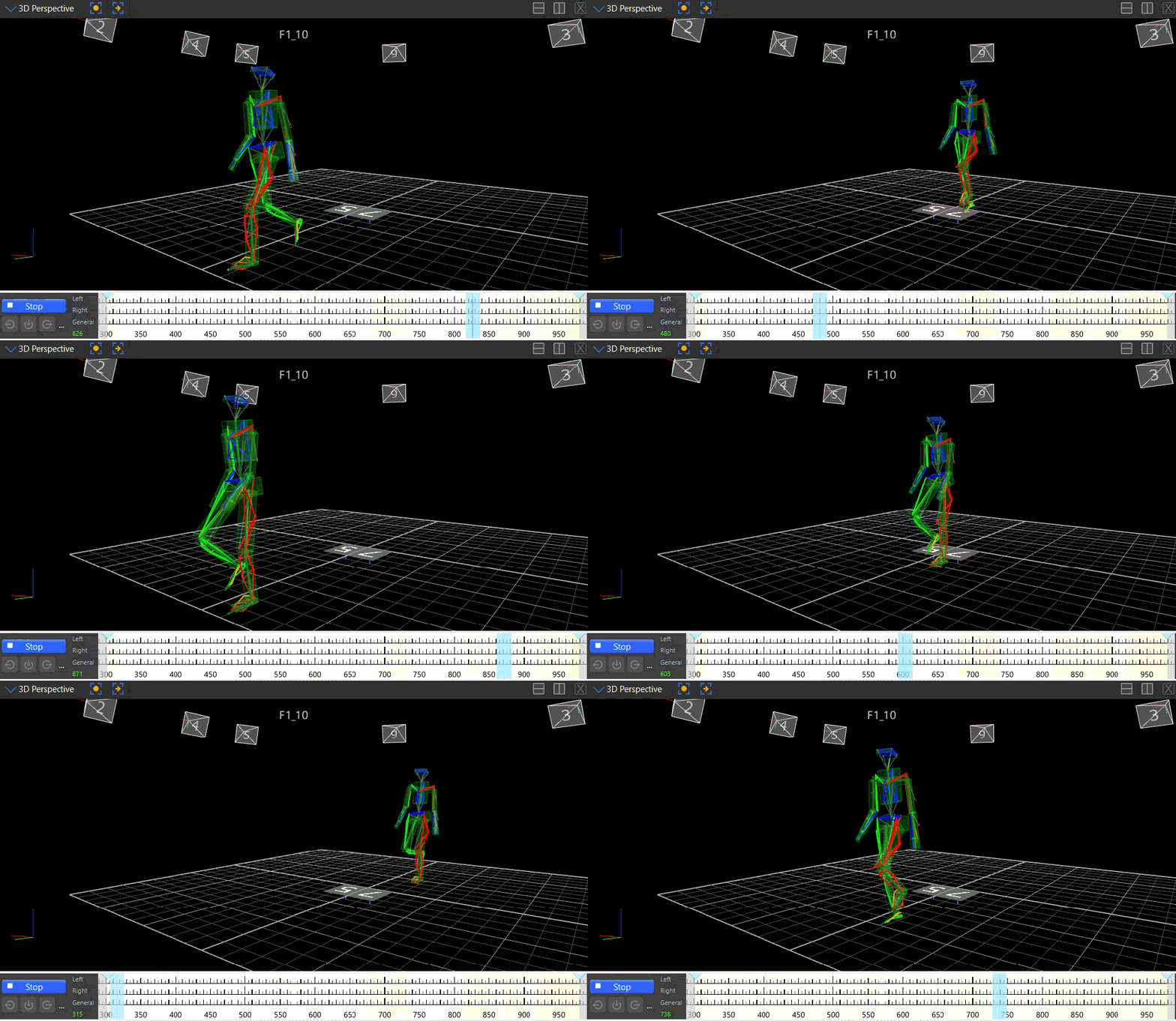
You will be asked to walk barefoot on different surfaces — including uneven platforms, sand, and foams of varying thickness (see video below). Your whole body movements will be recorded using 3D motion capture software and pressure-sensitive mats. These systems use a high resolution camera system to record motion of the body but do not record any identifying images of you. We will take some basic biometric information such as your body mass and height, but these are non-identifying.
XROMM (‘X-Ray Reconstruction of Moving Morphology’) will be used to capture foot movements walking across different types of compliant surfaces to track movement across each substrate, whilst force plates (novel electronics inc.) will record ground reaction forces corresponding to each substrate. This approach will be complemented by 3T MRI scans of the participants to provide 3D bone geometries, aiding in the XROMM data processing.
PARTICIPANT SAFETY:
For radiation safety participants will wear a lead apron, thyroid shield and glasses, and a dosimeter over and underneath the apron.
Previous X-ROMM studies from this lab have demonstrated that in 27s the exposure was a mean of 1.5 μSv across all participants. This is significantly less than the amount of radiation a person would typically be exposed to in everyday activities, such as walking around a city. For example, the average person receives about 10 μSv per day from natural background radiation, which includes cosmic rays, radon gas, and other sources. Therefore, the exposure levels in this project are indeed minimal and well within safe limits. The exposure amount is lower than the natural exposure of radiation from a day spent walking around Kingston.
WHEN IS IT? WHERE DO I GO?
Address: The Skeletal Observation Laboratory at Queen’s University, Hotel Dieu Hospital, 166 Brock Street, Kingston, Ontario, Canada K7L 5G2.
When: 16th-25th September
We have morning and afternoon sessions available! Chat to us to find out availability. If you are busy these days but would still like to participate, then please do let us know! There is a chance that we may have future dates.

WHAT DO I NEED TO WEAR?
You will be required to wear tight-fitting, minimal clothing. There are changing room facilities on site for you to change your outfit — no need to walk through Kingston minimally dressed! If you need to change on site, please arrive 5 minutes before your session so that you are dressed and ready to go for the start of the session. During the experiments, you will have markers taped to your upper and lower limbs with hypoallergenic tape; this should not cause any discomfort or irritation. We kindly ask you to avoid using moisturiser on the day, as it can reduce the tape’s adhesiveness to your skin. Alcohol wipes will also be provided to prepare the skin before markers are attached.
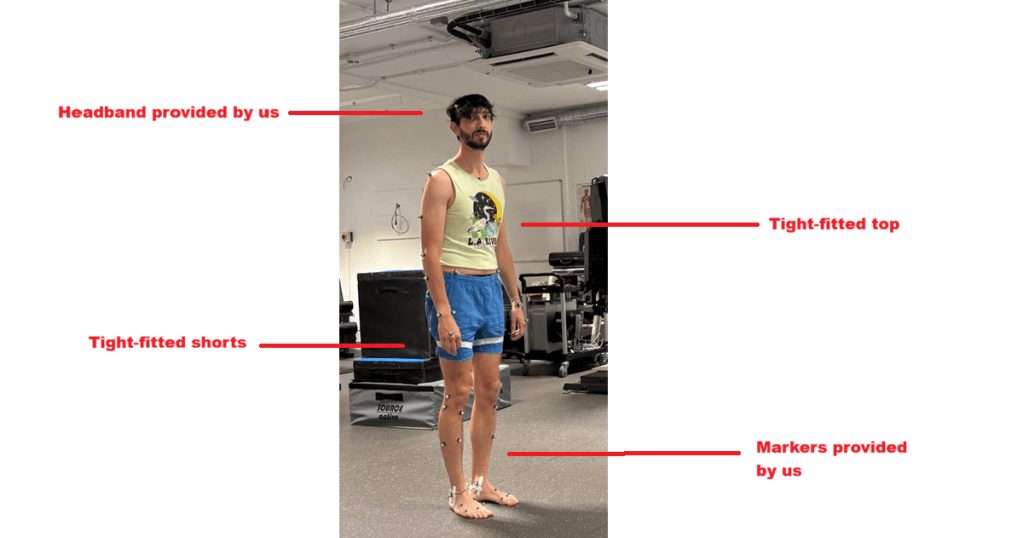
Please wear shorts. This is because we need to place markers directly onto the skin around your knees and ankles. If your clothing is too loose/baggy, we will use masking tape to tighten clothing — you can see this approach in the above image on the blue shorts.
This study has received Ethical Approval by the University of Cambridge and the Skeletal Observation Lab.
Thank you for considering participation in this study. Your contribution will help advance our understanding of human and hominin locomotion.
Are you ready to sign up? Email us at steps@arch.cam.ac.uk!

