Our latest paper from the DAWNDINOS project has just been published – see it here! Our paper tackles a conundrum in evolutionary biomechanics – how can we accurately estimate the size (PCSA; Physiological Cross Sectional Area) of a muscle in fossil specimens when soft tissues do not preserve? And why is this important? Well, the PCSA of a muscle is correlated with the maximum force that a muscle can exert and if we underestimate such force then we might be understimating the true capability of an extinct species. And if we over-estimate? Then we have an over-bulked, Hulk-critter. Functionally speaking, we could inaccurately predict that a species was incapable of moving in a certain way. One long standing theory suggests that the size of the muscle’s attachment site is ~correlated to the PCSA of the muscle and that it might be possible to use the attachment site to calculate the PCSA. Whilst there’s a large scope of research out there testing such relationships in skulls, little research has yet tackled this problem in limbs.
In our latest paper, we tested the correlation between muscle attachment area and PCSA in five Nile crocodiles, six tinamous (both from the DAWNDINOS project), a wild turkey, a domestic chicken, an emu and an ostrich (the latter species were from John Hutchinson’s postdoc in 2001!). All specimens were dissected, attachment sites were digitised and we computed a whole bunch of statistics to ascertain the relatioship between the sites and PCSA (note: such approaches will make you develop a love-hate relationship with SPSS in the end!)
So… did we do it? Did we find the relationship? Well.. sort of. The ratios vary A LOT and are very much muscle-dependant. The ratios are not reliable across species (archosaurs), but were instead more similar within a species, hinting that for most muscles it is possible to apply a “one size fits all estimation approach”. We tested our prediction on crocodiles, tinamous, ostrich (a larger-body sized aves) and on the extinct Coelophysis. Our results are a mixed bag, with pros and cons. Importantly, our approach demonstrates that there is a lot we still don’t know about musculature and how to estimate muscle force for extinct species.
There’s definitely a lot more still to be said and done about such approaches and I wait with anticipation for future research which tackles such a problem!
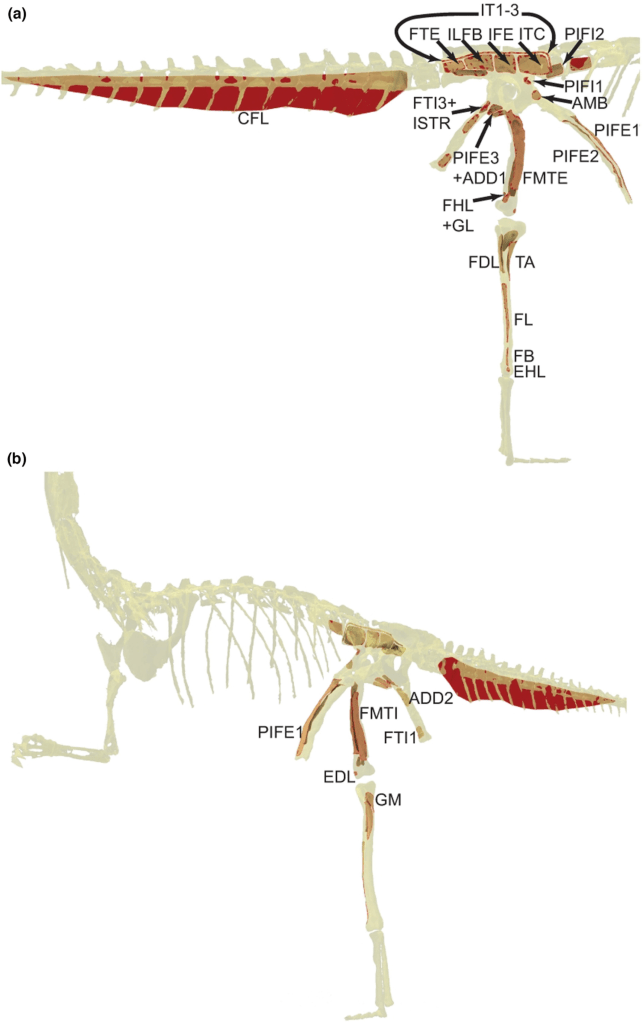
Figure 8 from the paper. Figure shows reconstructed muscle attachment sites of Coelophysis bauri.


Leave a Reply